Local SEO for Tradies: How to Show Up When Customers Search
Local SEO for Tradies: How to Show Up When Customers Search
A practical guide for tradies who want to be the business people find first when they urgently search for help in their local area.
When someone's hot water system dies on a Sunday morning, they don't browse. They pull out their phone, type something like "plumber near me", and call one of the first businesses that appears.
If you're not one of them, you don't lose that job on price or quality. You lose it because they never knew you existed.
That's what local SEO is for. It's the work of showing up when people in your area search for what you do, and it's one of the few kinds of marketing where the customer arrives already wanting to hire someone.
What Local SEO Actually Means
Forget the jargon. Local SEO is how Google decides which businesses to show when someone searches for a service in a particular area.
There are two places you can appear:
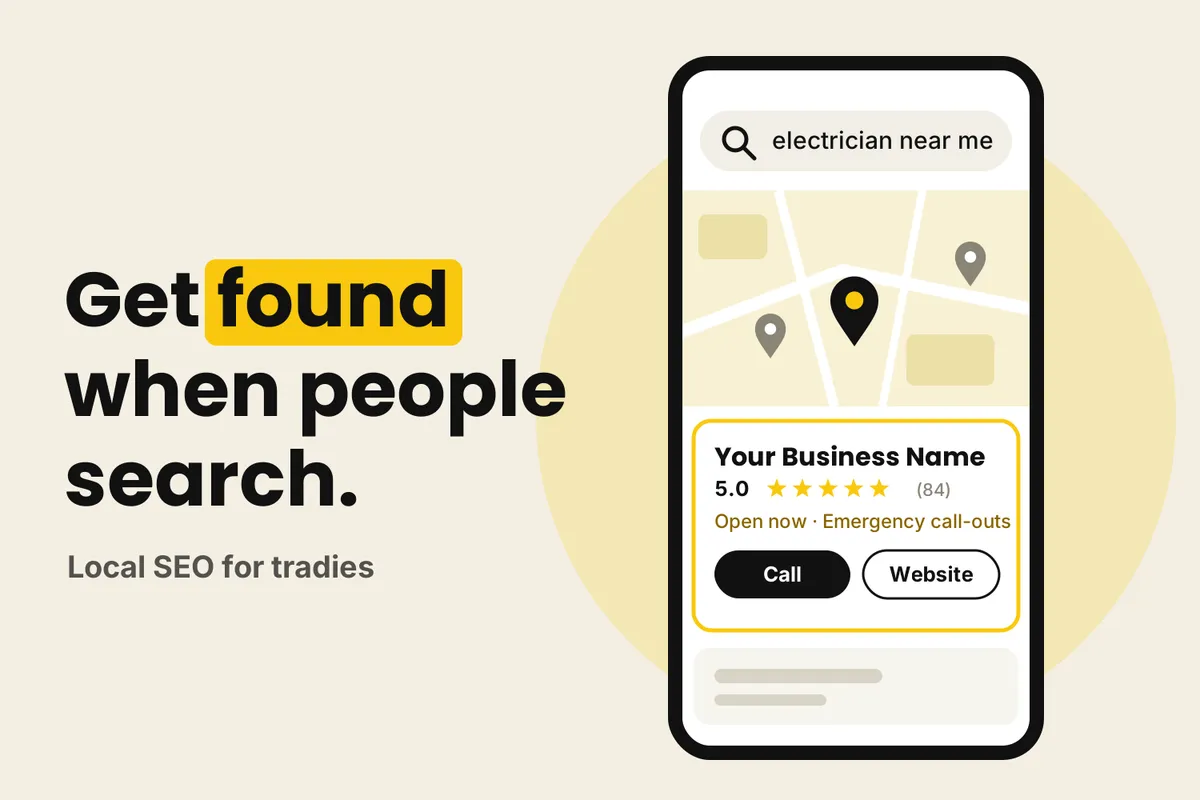
The map results. The block of three businesses with a map, ratings and a call button, usually sitting above everything else.
The regular results. The website links underneath.
For urgent, local searches like "electrician Joondalup" or "emergency plumber near me", the map results get most of the attention. That's why most of this guide is about getting into that top group.
📌 Key Takeaway: If you’re not in the top map results, you’re often invisible to people searching in a hurry.
How Google Decides Who Shows Up
Google has been fairly open about this. For local searches, it weighs three things:
Relevance. How well your business matches what the person searched for. A profile that clearly says "electrician" will beat one that vaguely says "home services."
Distance. How close your business is to the person searching, or to the area they named. You can't change where you're based, but you can be clear about the areas you cover.
Prominence. How well known and trusted you appear to be. Reviews, a proper website, and your details appearing consistently across the internet all feed into this.
Notice that none of those three is "who spends the most." This is a game tradies can win with consistency, not budget.
Step 1: Get Your Google Business Profile Right
Your Google Business Profile (the free listing that appears on Maps and in search) is the single most important local SEO asset you have. Most tradies set it up once and never touch it again. Here's what to check:
Choose the right primary category. Pick the one that matches your main trade exactly, such as "Electrician" or "Plumber", not something broad. Your primary category carries a lot of weight. Add secondary categories only for services you genuinely offer.
Set your service areas honestly. If you travel to customers, list the suburbs or regions you actually cover. Listing every suburb in the state doesn't help, and it can look like you're stretching the truth.
Fill in every section. Opening hours, a phone number that gets answered, a short description in plain language, and your website link. An incomplete profile signals an inactive business.
Add real photos regularly. Your van, your team, finished jobs. Fresh, genuine photos show you're operating and give people something to trust before they've spoken to you.
Keep your hours accurate. If you offer after-hours or emergency work, say so. It's one of the quickest ways to win the urgent searches.
💡 Pro Tip: Treat your Google Business Profile like a second website. Update it whenever your services, hours or contact details change.
Step 2: Make Sure Your Details Match Everywhere
Google cross-checks your business information across the internet. If your name is "Smith Plumbing" on your website, "Smith Plumbing & Gas" on Facebook and "J Smith Plumbing" on a directory, you're sending mixed signals.
Pick one exact version of your business name, address (or service area) and phone number, and use it everywhere: your website, your Business Profile, your social pages and any trade directories you're listed in. It's dull work, but it's one of the quiet foundations of trust in Google's eyes.
"Consistency of your business name, address and phone number is one of the strongest basic signals in local SEO."
— Local search best practice
Step 3: Build Your Website to Support It
Your website and your Business Profile work as a pair. A few things make a real difference:
A page for each main service. Rather than one page listing everything, give "hot water repairs" or "switchboard upgrades" its own page. That's far more likely to match a specific search.
Mention the areas you serve, naturally. Say which suburbs and regions you cover, in a way a real person would read. Don't paste a list of 50 suburbs into the footer.
Show proof of local work. A short write-up of a recent job with the suburb, the problem and the result tells Google and customers the same thing: you work here.
Make it fast and mobile-friendly. Most local searches happen on phones, and a slow or awkward site loses people before they ever read a word.
💡 Pro Tip: If you’re not sure how your site performs on mobile, open it on your phone and try to make a booking as if you were a new customer.
Step 4: Let Reviews Do the Heavy Lifting
Reviews feed directly into prominence. A steady flow of recent, genuine reviews tells Google, and customers, that you're active and trusted. Responding to them, including the occasional bad one, adds to that.
If you want a practical way to make this consistent, we covered it in our guide to getting customers to actually leave 5-star reviews.
📌 Key Takeaway: Aim for a slow, steady stream of reviews each month instead of a one-off spike.
A Quick Example
Picture two electricians in the same suburb.
One has a bare-bones Business Profile with the wrong category, no photos, inconsistent business names across the web and a website that loads slowly. The other has a complete profile, the right category, regular photos, matching details everywhere and a steady run of recent reviews.
Both do good work. When someone searches "electrician near me" at 7pm, only one of them gets the call. The difference isn't skill. It's who made it easy for Google to understand and trust them.
Common Mistakes to Avoid
Stuffing in keywords. Adding extra words to your business name on Google to try to rank higher breaks Google's rules and can get your profile suspended. Use your real business name.
Using a fake address or virtual office. Google is strict about this. If you work from home, use service-area settings and hide your address instead.
Buying reviews or asking friends to write them. Platforms are getting better at spotting this, and customers can usually tell. Genuine reviews from real jobs are the only kind worth having.
Setting it up once and forgetting it. Local rankings favour businesses that look active. A little attention every month beats a big effort once a year.
⚠️ Warning: Trying to “trick” Google with fake locations or names often leads to suspensions that are slow and painful to fix.
Where to Start This Week
You don't need to do everything at once. In one sitting, you can:
Check your Google Business Profile's primary category is the right one
Confirm your phone number, hours and service areas are accurate
Add five genuine photos of recent work
Make sure your business name and phone number match exactly on your website and social pages
That alone puts you ahead of a surprising number of local competitors. Then, over the following weeks, work on building out service pages and a steady flow of reviews.
Local search rewards the businesses that are clear, consistent and active. If you're already doing good work in your area, the aim is simply to make that easy for Google, and for customers, to see.
Growth Systems Co helps Australian tradies and home-service businesses turn more searches into booked jobs, with websites, automation and review systems that run in the background while you're on the tools.